5 Simple Habits Quietly Hurting Your Health (and How to Fix Them)
Jun 24, 2024
5 Simple Things Impacting Your Health | Oncology Nutrition Tips
When people think about lowering their cancer risk or supporting their body through treatment, they usually picture a complete overhaul.
But in my experience working with clients on an anticancer, oncology-focused nutrition plan, tackling even one of these points moves the needle in a big way.
Client protocols are created with stages build in, to encourage manageable changes to daily habits; the ones that feel too ordinary to question. Below are five of the most common ones I see, along with what the research actually says about each.
1. Avoiding {healthy} fat
Fat does not "make you fat." I know this is a hard one to unlearn, but it simply isn't true.
We've had proof since 2016 that the sugar industry paid off several Harvard scientists in the 1960s to skew the results of their study. The scientists blamed fat for unwanted weight gain rather than sugar. Sugar increases cholesterol levels, not fat. Saturated fat raises HDL ('good' cholesterol) and, while it can also raise LDL, growing research suggests LDL particle size and type matter more than total LDL for cardiovascular risk.
While some people have a genetic predisposition to gain weight quickly from saturated forms of fat, the majority of us do not. Regardless of genetics, all of us need healthy fat in our diets.
Fat is one of the three macronutrients that should make up a healthy diet. Eating a low fat diet...
- alters the absorption of nutrients, especially the fat-soluble vitamins A, D, E, and K.
- worsens your fatigue: fat is a "slow burning" source of energy, crucial to getting you through the day.
- alters function of neurotransmitters (like dopamine and serotonin) and hormones
- makes it harder for you to create leptin, the satiety hormone that makes you feel full.
2. Not drinking enough filtered water
Most Americans are dehydrated. Have you had enough water today?
A good starting point is your weight in lbs ÷ 2 = ___ oz to drink per day.
No, coffee does not count. It's a diuretic and actually subtracts from your overall water intake for the day. Count only filtered water and non-caffeinated teas.
Daily hydration calculator
Find your baseline water goal, then adjust for your life.
Do any of these apply to you?
Signs of dehydration
Early:
- Thirst
- Dry mouth
- Fatigue
- Darker urine
- Cravings
- Muscle cramps
- Anxiety
- Headaches/Migraines
- Decrease in memory or ability to concentrate
Chronic:
- Heartburn
- Back pain
- Joint pain
- Constipation
Additionally, not drinking enough water leads to:
- slowed digestion
- lack of moisture to joints
- dry throat and lungs
- decreased toxin flushing
- headache/migraine
- fatigue
- “sticky blood” leads to high blood pressure and increases risk of blood clots
Learn more about water filtration systems here.
Try out these hydrating beverages.
3. Eating mostly processed foods
A processed food is any edible food not in its whole form.
Unless it only contains a only a few ingredients on the label and you know exactly what they are....example: organic apple puree... this includes virtually anything you'd buy in the center aisles of the grocery store.
Most of these products contain artificial ingredients and have been altered to increase "palatability."
They:
- alter and damage the microbiome
- contain synthetic vitamins such as folic acid which block receptor sites
- Folic acid competes with active folate (5-MTHF) at folate receptors when it builds up unmetabolized in the bloodstream, potentially blocking real folate uptake, including across the blood-brain barrier.
- are made of empty calories leading to overeating without getting the necessary nutrients
4. Excess sugar in your diet
Although it tastes good, sugar takes a lot more than it gives.
Sugar:
- affects sleep and mood patterns
- alters gut microbiome
- provide extra fuel for abnormal cell growth
- Cancer cells preferentially use glucose via glycolysis
- makes naturally sweet things taste less sweet
- increased cravings
Sugar causes real addiction, so try not to feel shame for wanting it so intensely. It will take time reduce your intake.
Start by buying unsweetened versions of the products you already buy. Example: oat milk, coffee, and other beverages. These drinks are a major source of sugar, so reducing your intake will have a big impact.
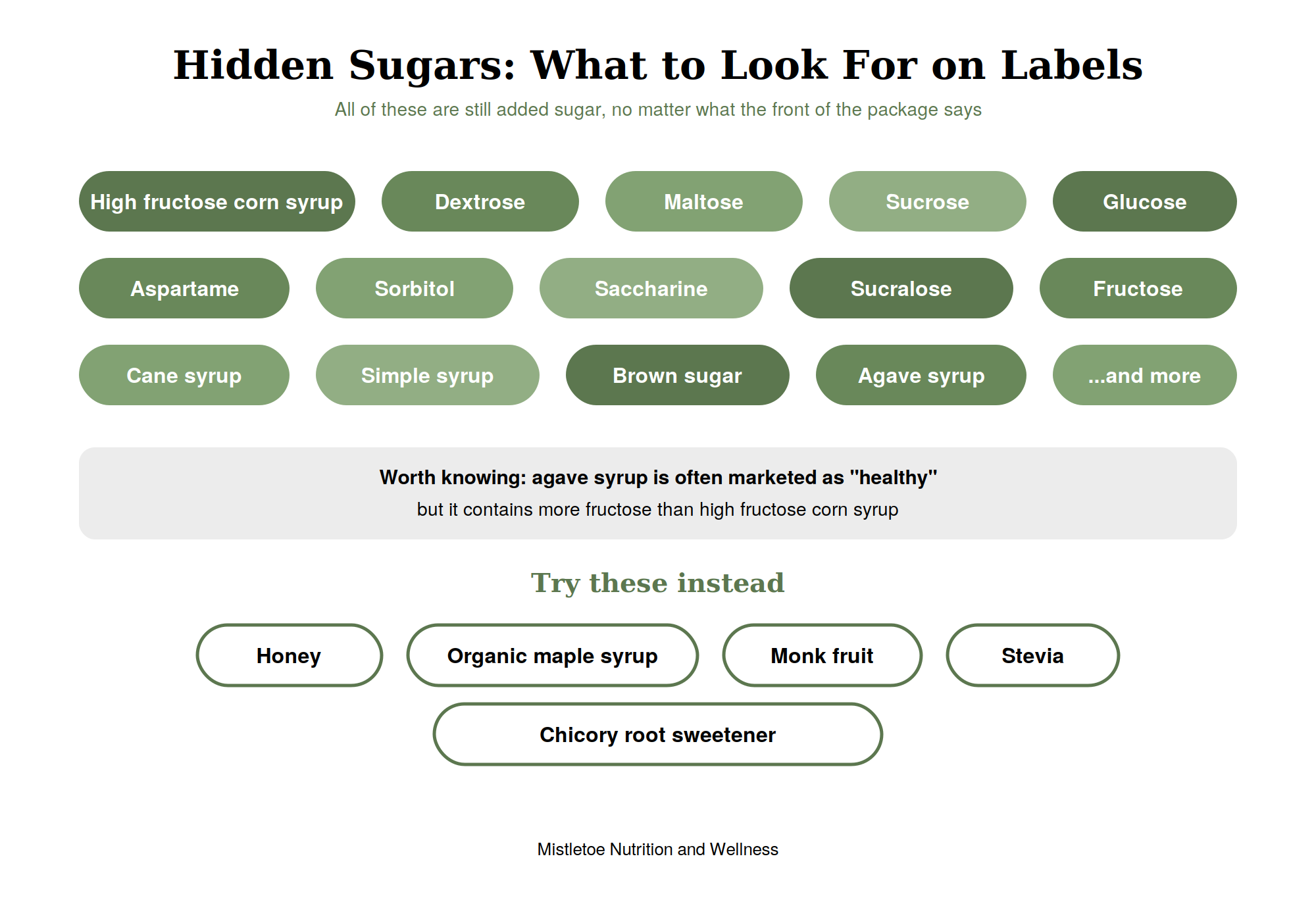
Next, begin replacing any refined sugars with natural sources like honey, organic maple syrup, monk fruit, stevia, or chicory root sweetener.
Agave syrup is commonly accepted as a "healthy option" but it contains more fructose than high fructose corn syrup.
Check your food labels for hidden sugars:
How are you supposed to break the habit if you're being systematically dosed with sugar throughout your whole day?
Ask for no sugar added or "unsweetened" when you order your coffee or tea.
The less you eat it, the less you will crave it. And as you cut back on refined sugars, your taste will adjust back to normal. Trust me, white sugar will soon taste WAY too sweet.
5. Eating after dinner
Digesting food takes a lot of energy and resources. Your body will prioritize it over falling asleep every time.
- affects overall sleep quality and ability to fall asleep
- reduces cellular clean up and repair overnight
- weight gain
Take Away
Pick one item to focus on this week!
Habits take time to form and trying to change everything at once isn't sustainable. Master one new habit and make it a part of your routine before you move on to the next.
To start lowering your toxic burden and adopt an anticancer lifestyle, check out my Basics of Anticancer Nutrition Course.
To learn more about oncology support, check out my services page here.
Your first step is to book a Discovery Call.
Citations:
- Kearns CE, Schmidt LA, Glantz SA. Sugar Industry and Coronary Heart Disease Research: A Historical Analysis of Internal Industry Documents. JAMA Intern Med. 2016;176(11):1680-1685. https://doi.org/10.1001/jamainternmed.2016.5394
- Mensink RP, et al. Effects of dietary fatty acids and carbohydrates on the ratio of serum total to HDL cholesterol and on serum lipids and apolipoproteins: a meta-analysis of 60 controlled trials. Am J Clin Nutr. 2003;77(5):1146-1155. https://doi.org/10.1093/ajcn/77.5.1146
- Leguminous fractions as encapsulating agents of fat-soluble vitamins. Explor Foods Foodomics. 2024. https://doi.org/10.37349/eff.2024.00030
- Impact of Food Intake and Sleep Disturbances on Gut Microbiota. Cureus. 2024. https://pmc.ncbi.nlm.nih.gov/articles/PMC11531926/
- Sweeney MR, et al. Folic acid inhibits 5-methyltetrahydrofolate transport across the blood–cerebrospinal fluid barrier. JIMD Rep. 2022. https://pmc.ncbi.nlm.nih.gov/articles/PMC9626660/
- Field MS, et al. High folic acid consumption leads to pseudo-MTHFR deficiency, altered lipid metabolism, and liver injury in mice. J Nutr Biochem. 2015. https://pmc.ncbi.nlm.nih.gov/articles/PMC4340065/
- Added sugars, gut microbiota, and host health. Nutr Res Rev. 2025. https://pmc.ncbi.nlm.nih.gov/articles/PMC12674407/
- Noble EE, et al. Gut microbial taxa elevated by dietary sugar disrupt memory function. Transl Psychiatry. 2021. https://doi.org/10.1038/s41398-021-01309-7
Shahdadian F, Boozari B, Saneei P. Association between short sleep duration and intake of sugar and sugar-sweetened beverages: a systematic review and meta-analysis. Sleep Health. 2023;9:159-176. - Chinedu SN. Cancer and Glucose Metabolism: A Review on Warburg Mechanisms. Trop J Nat Prod Res. 2022;6(5):661-667.
- Different Types of Sweeteners – Are Some Better Than Others? 2023. https://extension.unh.edu/blog/2023/10/different-types-sweeteners-are-some-better-others
- Vujović N, et al. Late isocaloric eating increases hunger, decreases energy expenditure, and modifies fat tissue distribution in humans. Cell Metab. 2022;34(10):1486-1498. https://doi.org/10.1016/j.cmet.2022.09.007
- The Association of Unhealthy Eating Behaviors with Sleep Quality Outcomes Among University Students. 2024. https://pmc.ncbi.nlm.nih.gov/articles/PMC12655729/
© 2024 Mistletoe Nutrition and Wellness LLC
Disclaimer: The information shared on this blog post is intended for inspirational and informational purposes only and is not a substitute for medical advice. Nothing on this blog post is intended to diagnose, treat, prevent, or cure any disease. Consult with your healthcare provider before making any dietary, lifestyle, or supplement changes and do not forego or delay seeking medical attention based on the information shared on this blog post. You acknowledge and agree that the results of any of our services, offerings, or products as described in a testimonial are not typical, are for illustrative purposes only, and cannot be guaranteed or assumed to be achievable by you. Please always consider your personal situation and do your own research.
Book a free Discovery Call to learn more.
Stay connected with news and updates!
Integrative cancer care resources, anti-cancer recipes, and whole-person health articles for those with a cancer diagnosis - at any stage of survivorship.
I don't spam, and I will never sell your information, for any reason.
